
Fufu
Fufu (Foo-foo, Foufou, Foutou, fu fu) is to Western and Central Africa cooking what mashed potatoes are to traditional European-American cooking. There are Fufu-like staples all over Sub-Saharan Africa: i.e., Eastern Africa's Ugali and Southern Africa's Sadza (which are usually made from ground corn (maize), though West Africans use maize to make Banku and Kenkey, and sometimes use maize to make Fufu). Fufu is a starchy accompaniment for stews or other dishes with sauce. To eat fufu: use your right hand to tear off a bite-sized piece of the fufu, shape it into a ball, make an indentation in it, and use it to scoop up the soup or stew or sauce, or whatever you're eating.
In Western Africa, Fufu is usually made from yams, sometimes combined with plantains. In Central Africa, Fufu is often made from cassava tubers, like Baton de Manioc. Other fufu-like foods, Liberia's dumboy for example, are made from cassava flour. Fufu can also be made from semolina, rice, or even instant potato flakes or Bisquick. All over Africa, making fufu involves boiling, pounding, and vigorous stirring until the fufu is thick and smooth.

What you need
- two to four pounds of yams (use large, white or yellow yams; not sweet potatoes, not "Louisiana yams"); or equal parts yams and plantain bananas
- one teaspoon butter (optional)
What you do
- Place yams in large pot and cover with cold water. Bring to a boil and cook until the yams are soft (maybe half an hour). Remove pot from heat and cool yams with running water. Drain. Remove peels from yams. Add butter. Put yams in a bowl (or back in the empty pot) and mash with a potato masher, then beat and stir with a wooden spoon until completely smooth. This might take two people: one to hold the bowl and the other to stir.
- Shape the fufu into balls and serve immediately with meat stew or any dish with a sauce or gravy. To eat it, tear off a small handful with your fingers and use it to scoop up your meat and sauce.
Is Fufu a reduplication? See the Coupé-Coupé recipe
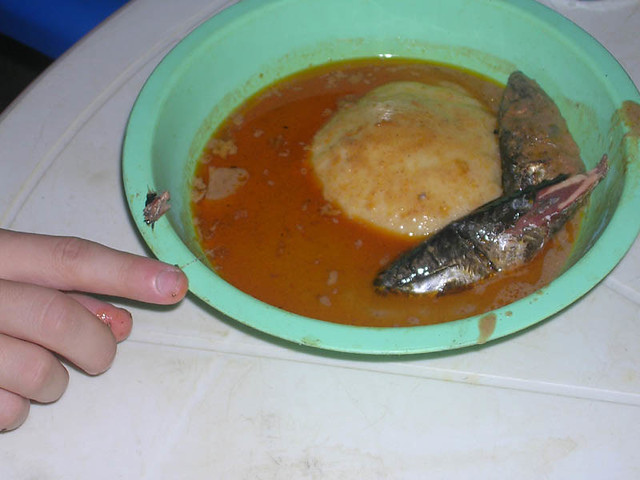
fufu in groundnut soup with fish
Semolina and Ground Rice Fufu
from Central Africa
What you need
- two to three cups ground semolina
- two to three cups ground rice
What you do
- Bring six cups of water to a boil in a large pot. Add the semolina slowly to the water, stirring constantly to avoid making lumps. Use a strong wooden spoon to stir constantly for a few minutes, until the mixture begins to thicken. You may need two people: one to hold the pot and one to stir. If the fufu seems thinner than mashed potatoes, add more of the semolina. Then add a roughly equal amount of the ground rice. Stir and cook for another ten minutes.
- Serve immediately with meat stew or any dish with a sauce or gravy. To eat it, tear off a small handful with your fingers and use it to scoop up your meat and sauce.
Instant Fufu
An out-of-Africa variation.
What you need
- two cups instant mashed potatoes
- two cups Bisquick
- two cups cassava flour or tapioca (tapioca is made from cassava tubers)
What you do
- Bring six cups of water to a boil in a large pot. Combine at least two of the three ingredients and add to the boiling water. Use a strong wooden spoon to stir constantly for 10-15 minutes. You may need two people: one to hold the pot and one to stir. If the fufu seems thinner than mashed potatoes, add more of the dry ingredients. The fufu should be very thick but must be stirred constantly to avoid lumping and burning.
- Shape the fufu into balls (this can be done by putting a cup of fufu into a bowl with a few spoonfuls of warm water and shaking the bowl back and forth until the fufu shapes itself into a ball). Serve immediately with meat stew or any dish with a sauce or gravy. To eat it, tear off a small handful with your fingers and use it to scoop up your meat and sauce.
Richard Francis Burton
Fufu is composed of Yam, Plantain, or Cassava
Richard F. Burton, the great 19th century traveler, writer, and translator, documented fufu in Wanderings in West Africa (New York: Dover Publications, Inc., 1991 "Two Volumes bound as One"; originally published by Tinsley Brothers, London, 1863).
<MAP NAME="boxmap-p8"><AREA SHAPE="RECT" COORDS="14, 200, 103, 207" HREF="http://rcm.amazon.com/e/cm/privacy-policy.html?o=1" ><AREA COORDS="0,0,10000,10000" HREF="http://www.amazon.com/exec/obidos/redirect-home/thecongocookb-20" ></MAP><img src="http://rcm-images.amazon.com/images/G/01/rcm/120x240.gif" width="120" height="240" border="0" usemap="#boxmap-p8" alt="Shop at Amazon.com">
"Fufu" is composed of yam, plantain, or cassava; it is peeled, boiled, pounded and made into balls, which act the part of European potatoes, only it is far more savoury than the vile tuber, which has already potatofied at least one nation, and which no man of taste ever looks, except in some such deep disguise as maitre d'hotel. There were also cakes seasoned with the fresh oil of the palm kernal, but they had a fault,--over richness.
(Volume II, Chapter IX, A Pleasant Day in the Land of Ants [Accra])
A dinner similar to breakfast is eaten at 4 to 5 P.M. Soup and stews are the favorite ménu, and mashed yam acts as a substitute for bread. It is also made into a spoon by a deep impression of the thumb, and thus it carries a thimblefull of soup with every mouthful of yam. The evening is passed with the aid of music, chatting with the women, and playing with the children.
(Volume II, Chapter X, Bonny River to Fernando Po)
